Steel column design is one of the most important topics in structural engineering. Columns carry loads from beams, slabs, roofs, and floors down to the foundation, so they must be designed for both strength and stability. A column may look like a simple vertical member, but in reality, its performance depends on many factors such as end conditions, slenderness, buckling resistance, section shape, and connection details.
In this guide, we will break down steel column design in a clear, practical way. Whether you are a student, site engineer, or design professional, this article will help you understand the core principles behind safe and efficient steel column design.
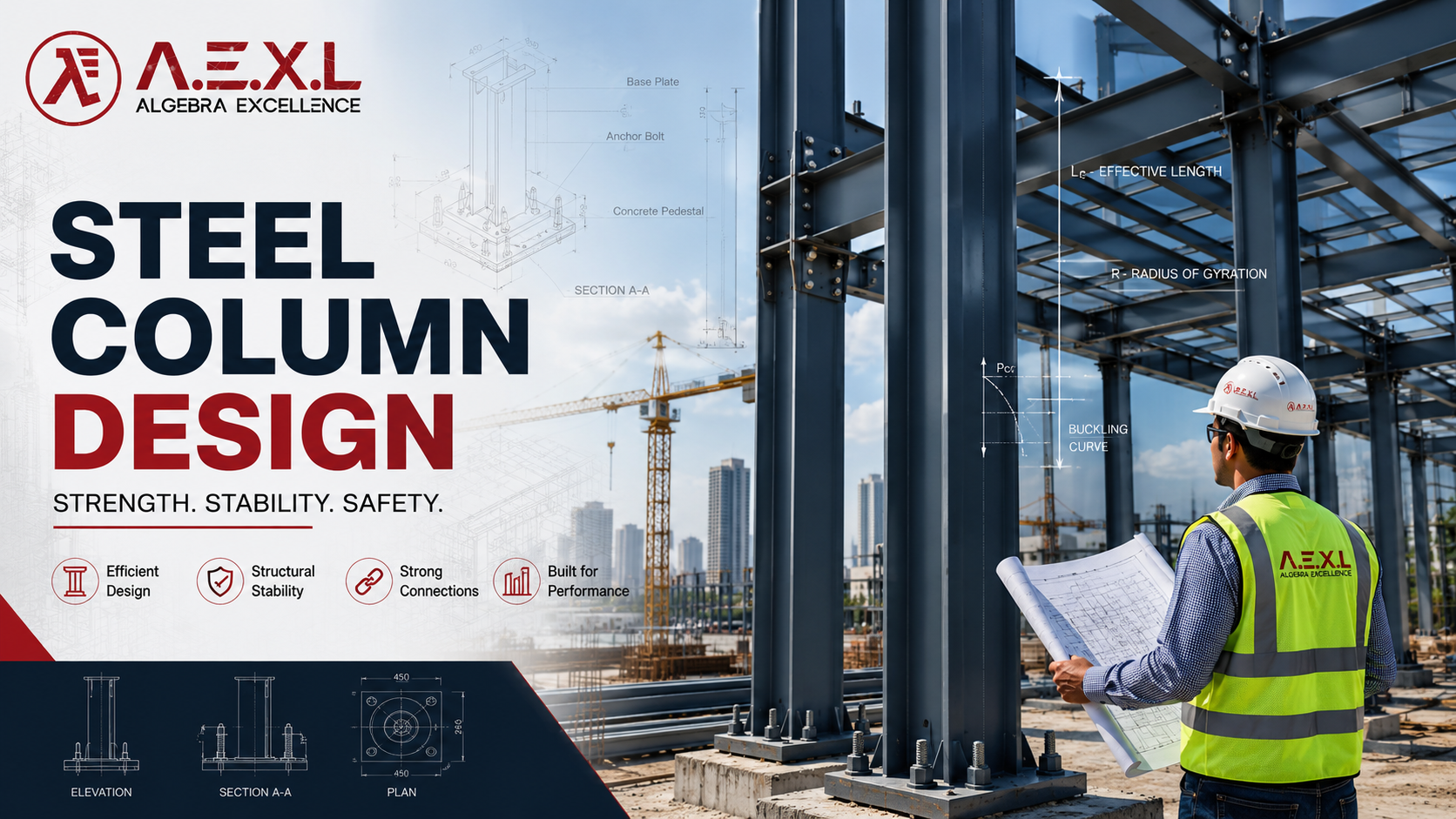
Free Steel Column Design Reference Sheet (PDF Download)
Looking for a quick reference while designing steel columns?
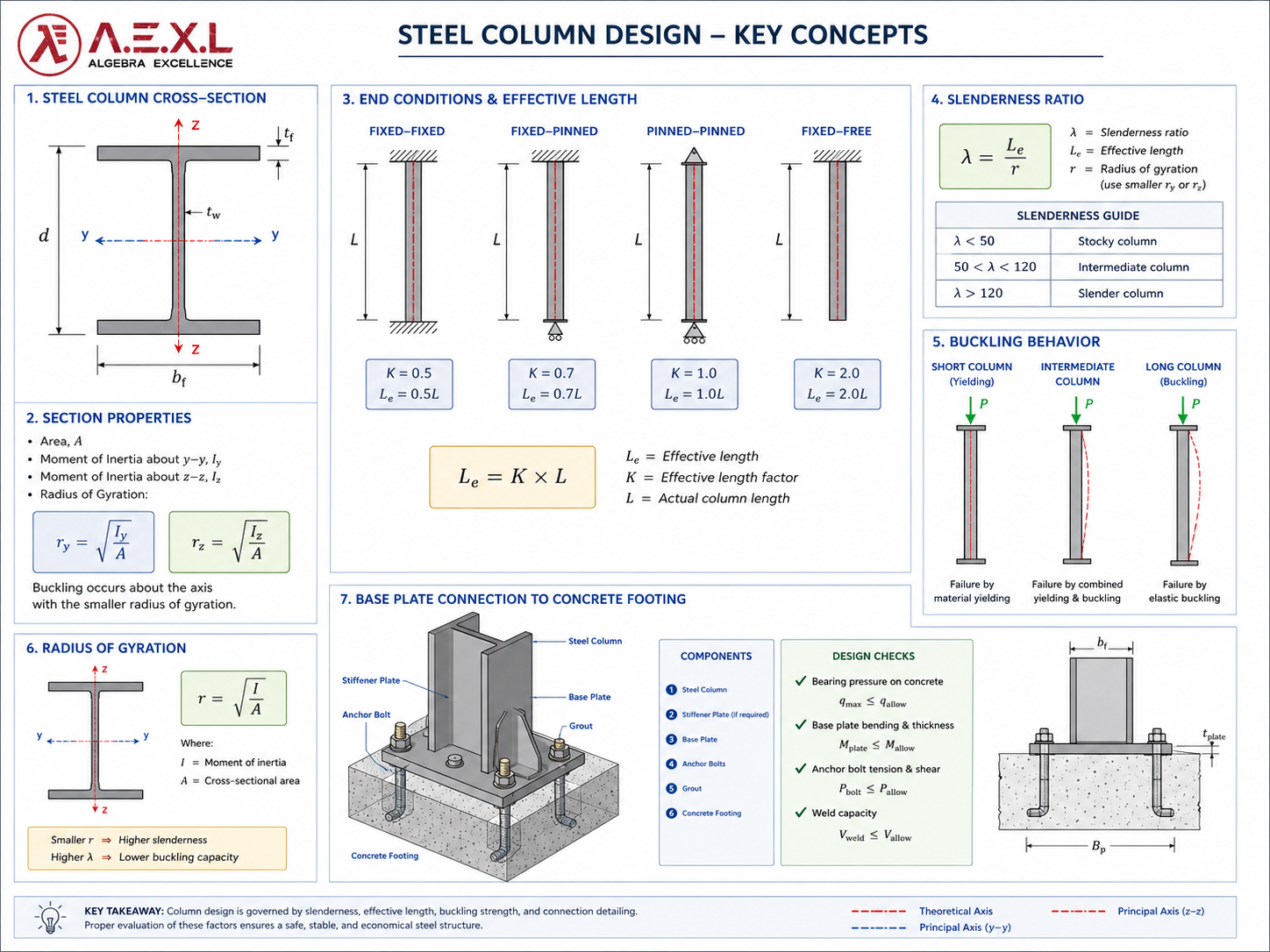
We’ve included a comprehensive 2-page Steel Column Design Reference Sheet that summarizes the most important concepts used in structural steel design, including:
- Steel column fundamentals
- End conditions and effective length factors
- Slenderness ratio calculations
- Radius of gyration formulas
- Euler buckling theory
- Short vs slender column behavior
- Steel section classifications
- Column curves and buckling resistance
- Base plate design principles
- Common column failure modes
- Practical BS 5950 steel column design checks
View or Download the Complete Steel Column Design PDF
Figure: Steel Column Design Reference Sheet
This reference sheet provides a condensed overview of the most important steel column design concepts used by structural engineers, site engineers, steel detailers, and engineering students. It serves as a practical companion for understanding buckling behavior, effective length calculations, column capacity checks, and design code requirements.
Tip: Bookmark this page or download the PDF for quick access during structural analysis, steel member selection, and design calculations.
What Is a Steel Column?
A steel column is a structural member that primarily resists compressive forces. It transfers loads from upper structural elements to the foundation. In real-world structures, columns rarely carry pure axial compression alone. They also experience bending moments, eccentric loading, imperfections, and lateral forces such as wind or seismic actions.
That is why steel columns must be checked not only for compressive strength, but also for buckling and overall stability.
Why Steel Column Design Matters
A steel column is only as good as its ability to stay stable under load. Even if the steel material is strong, a slender column can still fail by buckling before it reaches its full compressive capacity. This makes column design different from many other structural checks.
Good column design ensures:
- Safe transfer of loads to the foundation
- Resistance to axial compression and bending
- Control of global and local buckling
- Proper connection performance
- Long-term structural reliability
Common Types of Steel Columns
Steel columns are available in several standard shapes, and the choice depends on the design load, height, architectural requirements, and connection details.
Common section types include:
- I-sections
- H-sections
- Channel sections
- Angle sections
- Circular hollow sections (CHS)
- Square hollow sections (SHS)
- Rectangular hollow sections (RHS)
Each section behaves differently under compression. Hollow sections often perform well because they provide good buckling resistance in more than one direction.
End Conditions and Their Effect on Column Design
One of the most important factors in steel column design is the end condition. The way a column is restrained at its ends changes how it behaves under compression.
Typical end conditions include:
- Pinned–Pinned
- Fixed–Pinned
- Fixed–Fixed
- Cantilever
- Partially restrained conditions
These end conditions affect the effective length of the column, which is used in buckling calculations. The stronger the end restraint, the smaller the effective length and the better the column’s buckling resistance.
In simple terms:
- More restraint = better stability
- Less restraint = higher buckling risk
Slenderness Ratio in Steel Column Design
The slenderness ratio is one of the most important parameters in column design. It tells us how likely a column is to buckle.
Formula:
Slenderness ratio = Effective Length / Radius of Gyrationλ=rLe
Where:
- Le = effective length
- r = radius of gyration
A column with a low slenderness ratio is generally stockier and more stable. A column with a high slenderness ratio is more slender and more likely to buckle.
This is why slenderness is a key design check in steel compression members.
Radius of Gyration: Why It Matters
The radius of gyration describes how the cross-sectional area is distributed around an axis. It is a geometric property that directly influences buckling resistance.
Formula:
r=AI
Where:
- I = second moment of area
- A = cross-sectional area
A larger radius of gyration means the section is better at resisting buckling. This is one reason why section shape matters so much in steel column design.
Euler Buckling Theory
The infographic also highlights Euler buckling theory, which is the classical basis for understanding column instability.
Euler theory shows that long, slender columns can fail by buckling even when the material stress is below the yield strength. This means the member does not crush first; it bends sideways and loses stability.
Euler buckling is most relevant for:
- Long columns
- Slender members
- Well-aligned, idealized members
- Elastic buckling behavior
In real design, however, columns are never perfectly straight or perfectly loaded. That is why modern codes modify Euler theory using safety factors, imperfection allowances, and reduction factors.
Short Columns vs Slender Columns
Steel columns generally fall into two broad behavioral categories.
Short columns
Short columns usually fail by material yielding or crushing. Their strength is governed mainly by the capacity of the steel itself.
Slender columns
Slender columns usually fail by buckling. Their strength is controlled more by geometry, end restraint, and effective length than by steel strength alone.
This distinction is important because the design approach changes depending on which failure mode is expected.
Section Classification in Steel Design
Steel sections are classified based on their local buckling behavior. This helps determine whether a section can develop its full strength or whether local plate buckling will limit its capacity.
Section classification affects:
- Compression resistance
- Plastic capacity
- Moment capacity
- Buckling performance
A section may be strong in theory, but if its plate elements are too slender, local buckling can reduce its usable strength.
Steel Grades and Material Strength
The design capacity of a steel column depends partly on the steel grade. Higher grades generally provide higher yield strength, which can improve compression resistance.
However, stronger steel does not automatically mean a better column. If the column is too slender, buckling may still control the design. In many cases, section geometry and stability are more important than material strength alone.
Column Curves and Design Codes
Modern steel column design is based on code provisions rather than pure theoretical formulas. Design standards use column curves to account for imperfections, residual stresses, and real-world behavior.
These curves reduce the idealized strength predicted by Euler theory and provide a practical design resistance.
Depending on the code, column curves may vary based on:
- Section shape
- Buckling axis
- Slenderness
- Material grade
- Manufacturing method
This is why two sections with the same area may not have the same design strength.
Combined Axial Load and Moment
In real structures, columns often carry both:
- Axial compression
- Bending moment
This happens due to eccentric loading, frame action, wind loads, or imperfect alignment.
A column that is safe under axial load alone may fail when bending is added. That is why combined interaction checks are essential in steel column design.
A complete design must consider:
- Axial load
- Moment about one or both axes
- Buckling resistance
- Section capacity
- Stability under second-order effects
Base Plate Design
The steel column does not end at the member itself. The load must be transferred safely into the concrete foundation through a base plate.
A good base plate design must ensure:
- Adequate bearing on concrete
- Proper plate thickness
- Correct anchor bolt arrangement
- Resistance to uplift or overturning
- Safe transfer of axial load and moment
If the base plate is underdesigned, the column may fail at the connection level even if the steel member itself is adequate.
Common Failure Modes in Steel Columns
Understanding failure modes is essential for safe design. The main failure mechanisms include:
- Flexural buckling
- Local buckling
- Torsional buckling
- Combined buckling
- Connection failure
- Base plate failure
- Excessive bending due to imperfections
A well-designed column must resist all likely failure modes, not just one.
Practical Steps in Steel Column Design
A typical design process follows these steps:
1. Determine the design loads
Find the axial load, moments, and any lateral effects acting on the column.
2. Select a trial section
Choose a suitable steel section based on load and architectural constraints.
3. Identify the end conditions
Decide whether the column ends are fixed, pinned, or partially restrained.
4. Calculate the effective length
Use the correct effective length factor for the given support condition.
5. Check the slenderness ratio
Confirm that the column is not too slender for the applied load.
6. Verify section classification
Make sure the section is suitable for compression use.
7. Check compressive and buckling resistance
Compare the design resistance with the applied loads.
8. Check combined load and moment interaction
Include bending effects where necessary.
9. Design the base plate and connections
Ensure the load path continues safely to the foundation.
10. Review detailing and constructability
Check fabrication, erection, alignment, and practical site conditions.
Common Mistakes to Avoid
Some of the most common mistakes in steel column design include:
- Ignoring end restraint
- Using the wrong effective length
- Choosing a section based only on area
- Forgetting buckling checks
- Neglecting combined bending effects
- Underestimating base plate demands
- Overlooking local buckling
- Assuming higher steel grade automatically solves the problem
Avoiding these mistakes leads to safer and more economical designs.
Why Steel Column Design Is More Than Just Strength
A column is not designed only to “hold the load.” It must also remain stable, serviceable, and durable throughout the life of the structure. That is why steel column design involves a balance of:
- Material strength
- Geometric efficiency
- Buckling resistance
- Connection performance
- Foundation transfer
- Practical constructability
When these factors work together, the structure performs safely and efficiently.
Conclusion
Steel column design is a core part of structural engineering. The process may seem complicated at first, but it becomes much easier when broken into the right concepts: end conditions, slenderness ratio, radius of gyration, buckling, column curves, and base plate design.
The most important lesson is this: a strong column is not just a heavy or thick one; it is a stable and properly detailed one. A well-designed steel column must resist compression, avoid buckling, and safely transfer load through its connections into the foundation.
If you understand these fundamentals, you will be better equipped to analyze, design, and detail steel columns with confidence.