Introduction
The Abu Dhabi Public Realm Design Manual is one of the Emirate’s most important urban design frameworks. Produced by the Department of Municipalities and Transport (DMT), it sets the standards for how public spaces should be planned, designed, approved, constructed, operated, and maintained across Abu Dhabi. The manual applies to all public realm areas in the Emirate and is intended to raise the quality of streets, parks, plazas, waterfronts, and open spaces for residents and visitors alike.
Unlike a generic design guide, the PRDM is a regulatory document. It defines what counts as public realm, how public open space should be distributed, how streetscapes should function, and how sustainability must be integrated through Estidama. That makes it essential reading for developers, masterplanners, consultants, municipalities, and all other stakeholders involved in Abu Dhabi’s built environment.
What Is the Abu Dhabi Public Realm Design Manual?
The PRDM is a framework that guides the development of public realm across the Emirate. It establishes the standards for public open spaces and streetscapes so that they are safe, accessible, culturally expressive, and environmentally responsible. The manual is also linked to the Estidama Pearl Community Rating System at planning stage and the Public Realm Rating System at design stage.
In practical terms, the manual ensures that public space is not treated as leftover land. Instead, it is positioned as core urban infrastructure that supports community life, active mobility, social cohesion, and long-term city quality.
Why the PRDM Matters for Abu Dhabi’s Urban Future
The purpose of the manual is to ensure the development of a world-class public realm in Abu Dhabi. It aims to deliver attractive, comfortable, safe spaces, a variety of uses, stronger sustainability, health benefits, social cohesion, cultural expression, and universal access for people of determination.
The manual also frames public realm as part of a bigger city strategy. It is designed to work with the Open Space Framework, Urban Street Design Manual, Safety & Security Planning Manual, and Estidama systems so that public spaces are coordinated across planning, design, and operations.
View or Download the Abu Dhabi Pubic Realm Design Manual PDF
How the Manual Is Structured
The PRDM is organized into four main chapters plus appendices. The User Guide explains the context, jurisdiction, definitions, standards hierarchy, and approvals process. The Planning chapter sets the vision, principles, public open space methodology, and distribution standards. The Design chapter defines universal and hierarchy-specific regulations and design elements. The Operation chapter covers management, maintenance, and long-term public realm care. The appendices include the glossary, compliance checklist, plant list, irrigation tables, acknowledgements, and image credits.
This structure is useful because it takes a project from concept to operation in a single framework. It helps teams align early planning decisions with later construction and maintenance requirements.
What Counts as Public Realm in Abu Dhabi?
The manual divides public realm into two categories: Public Open Space and Streetscape. Public Open Space includes parks, gardens, plazas, squares, waterfronts, natural and semi-natural areas, green infrastructure, and open space within mosque plots. Streetscape includes the street right-of-way, medians, footpaths, trees, street lights, furniture, signage, and landscaped areas that shape the street environment.
This distinction is important because Abu Dhabi treats both the place where people gather and the network that connects those places as part of the public realm. That makes the PRDM a holistic urban design tool rather than a narrow landscape specification.
The Public Realm Planning Process
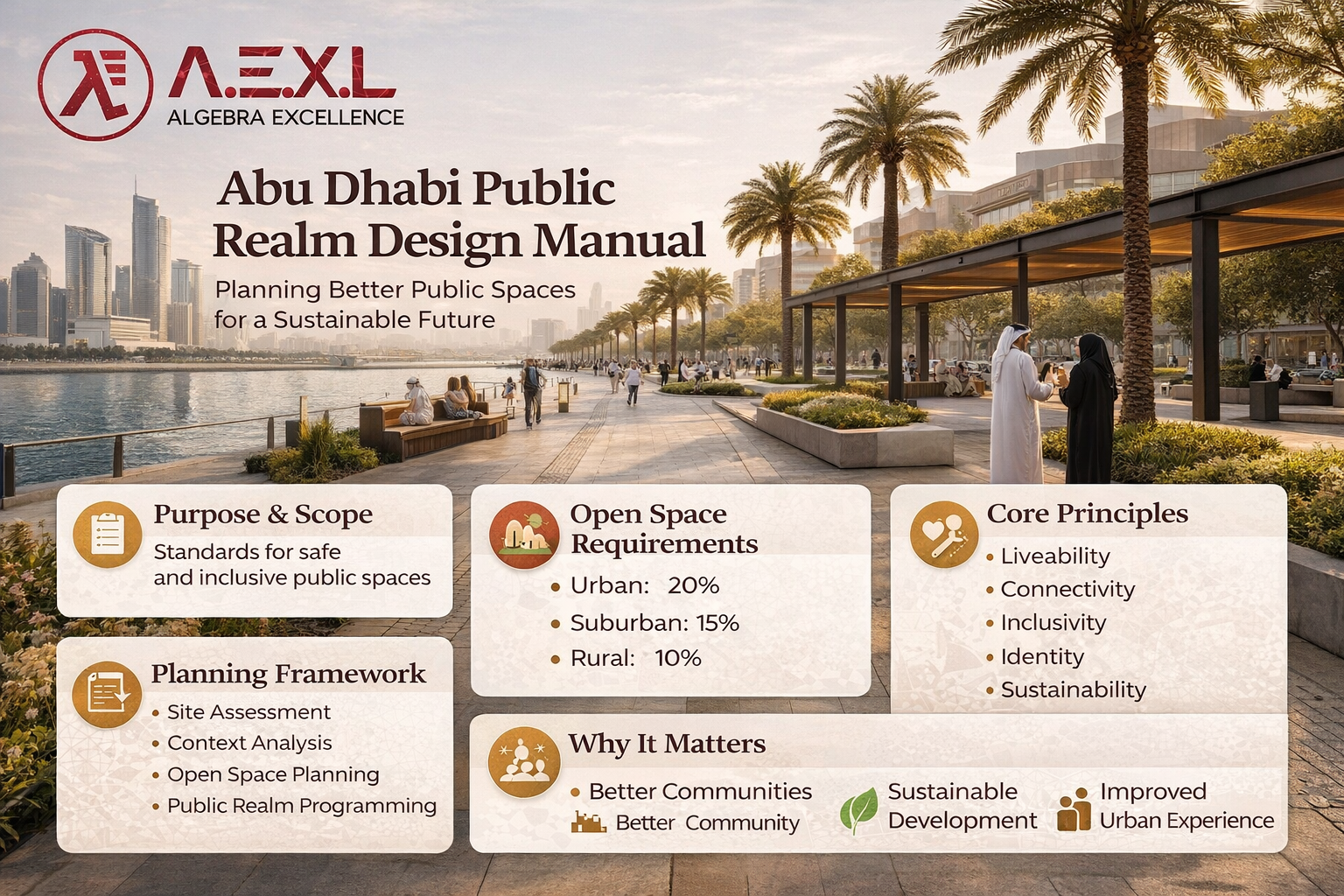
The planning chapter sets out a step-by-step process for new POS and streetscape projects. It begins with the PRDM Vision, Principles, and Policies, then moves into site boundary definition, Open Space Framework review, Natural Systems Assessment, site and context assessment, settlement context classification, public open space quantity calculations, distribution planning, and finally public realm programming.
The context assessment is especially important. The manual requires a site and surrounding-area review, including land uses, urban grain, character, existing open space provision, transit facilities, community facilities, and pedestrian and cycle routes. This ensures that public realm decisions respond to real site conditions instead of being imposed generically.
Public Open Space Requirements in Abu Dhabi
One of the most SEO-relevant and technically important aspects of the PRDM is the Public Open Space standard. The required POS percentage depends on settlement classification: 20% for Urban Settlements, 15% for Suburban Settlements, and 10% for Rural Settlements. The calculation excludes right-of-way, community facility plots, utility plots and corridors, and agricultural plots.
These standards are designed to make open space provision proportionate to settlement type. The manual also states that POS standards are based on international best practice and adapted to Abu Dhabi’s local settlement conditions.
The Three Main Types of Public Open Space
The manual says that overall POS allocation should be distributed across three types: Programmed Space, Sport and Recreation, and Play Facilities. The recommended proportions remain constant across settlement types, even though the total POS amount changes.
Programmed spaces can include parks, pocket parks, gardens, plazas, squares, linear parks, and pedestrian or cycle routes outside the right-of-way. Sport facilities range from small courts and hoops to full pitches, while play facilities include formal and informal play areas, skate parks, BMX trails, and adventure playgrounds.
The Six Core Principles of the PRDM
The PRDM is built around six design and planning principles.
Liveability
Public realm should be safe, comfortable, engaging, and supportive of physical and mental wellbeing.
Identity
Public spaces should express Arab culture, heritage, values, and traditions while reflecting local context.
Connectivity
The public realm should support continuous movement for walking, cycling, and other transport modes.
Placemaking and Design Excellence
Spaces should be high-quality, human-scale, visually interesting, flexible, and climate-responsive.
Inclusivity
Public spaces should work for all people and help promote community cohesion.
Environmental Stewardship
The public realm should conserve water, protect habitat, and improve energy efficiency.
How the PRDM Supports Sustainability
Sustainability is not an add-on in the PRDM. It is embedded through Estidama integration. The manual states that at planning stage the Pearl Community Rating System applies, while at design stage the Public Realm Rating System applies. The PRRS includes both mandatory and optional requirements, and required credits must be achieved for compliance.
This means public realm projects in Abu Dhabi are expected to meet sustainability requirements as part of the approval pathway, not simply as a design preference. The manual also includes planning standards for shading, softscape, hardscape, furniture, public art, water usage, lighting, signage, and safety and security, all of which reinforce performance as well as aesthetics.
The Approval Process for Public Realm Projects
The PRDM makes approvals a formal part of the process. For masterplans, public realm submission is handled as part of the broader Urban Development Review process with DMT. For stand-alone projects, the relevant municipality is the lead approval agency. In both cases, NOCs and Estidama compliance are required, and the process continues through concept, detailed design, construction permits, completion, and operation.
That approval structure is important because it ensures that design quality, technical compliance, and sustainability are checked before implementation. The manual is therefore both a design guide and a regulatory pathway.
Who Should Use the Abu Dhabi Public Realm Design Manual?
The manual is intended for developers, masterplanners, consultants, Estidama professionals, DMT teams, municipalities, government agencies, contractors, and anyone responsible for planning, approval, implementation, operation, or maintenance of public realm projects in Abu Dhabi.
Because the manual covers both strategic planning and detailed design, it is relevant from the earliest feasibility discussions all the way through construction and handover.
Why This Manual Is Important for Designers and Developers
For designers, the PRDM gives a clear framework for creating spaces that are functional, beautiful, and climate-responsive. For developers, it provides measurable standards that help projects move through approval more smoothly. For municipalities, it creates consistency across the Emirate. For communities, it supports safer, greener, more inclusive public spaces.
In short, the PRDM turns public realm into a strategic asset. It improves not only the appearance of places, but also how people live, move, meet, and experience Abu Dhabi.
Conclusion
The Abu Dhabi Public Realm Design Manual is a comprehensive framework for creating public spaces that are sustainable, inclusive, culturally grounded, and high-performing. It sets clear expectations for planning, open space provision, streetscape design, approvals, and long-term maintenance, while integrating tightly with Estidama and other DMT manuals.
For anyone involved in urban planning, landscape design, or development in Abu Dhabi, understanding the PRDM is essential. It is one of the main tools shaping the Emirate’s public spaces today and into the future.
Frequently Asked Questions
What is the Abu Dhabi Public Realm Design Manual?
The PRDM is Abu Dhabi’s official framework for planning, designing, approving, operating, and maintaining public realm projects across the Emirate.
What types of spaces are covered by the PRDM?
It covers public open space and streetscape, including parks, plazas, waterfronts, pedestrian areas, roadsides, and landscaped public areas.
How much public open space is required?
Urban settlements require 20%, suburban settlements 15%, and rural settlements 10% of the defined site area, excluding specified deductions.
Does the PRDM relate to Estidama?
Yes. The manual is linked to Estidama through the Pearl Community Rating System at planning stage and the Public Realm Rating System at design stage.
Who needs to follow the PRDM?
Developers, consultants, municipalities, DMT teams, contractors, and other public realm stakeholders involved in Abu Dhabi projects need to follow it.